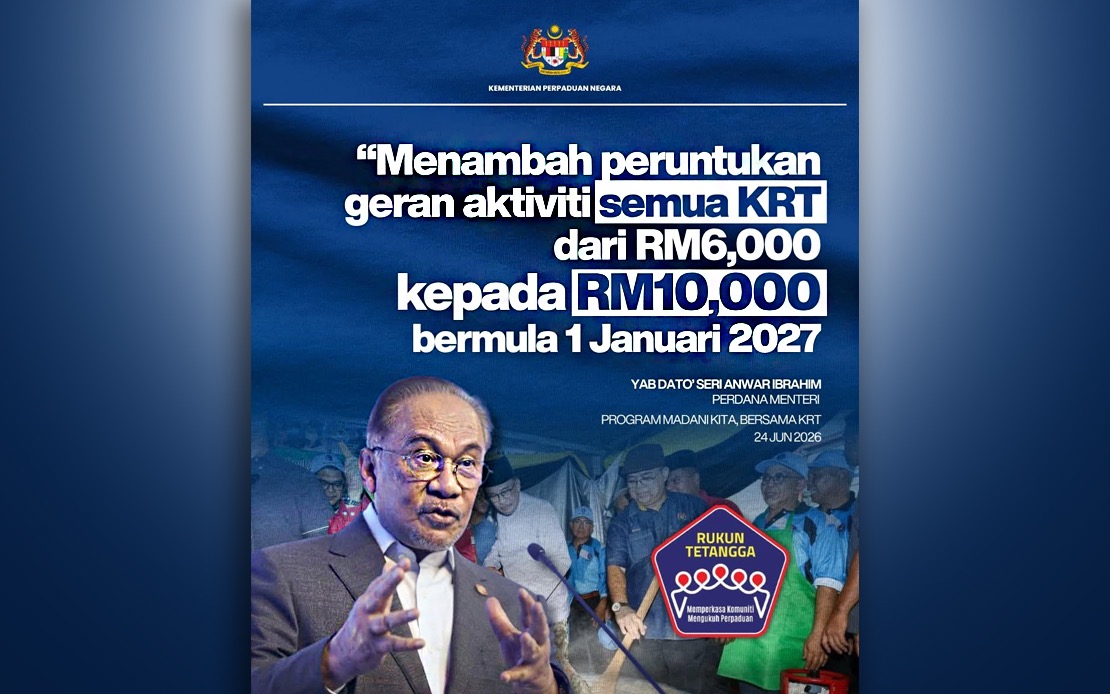
Prime Minister Datuk Seri Anwar Ibrahim has announced a significant financial uplift for Malaysia's neighbourhood watch movement, doubling the annual grant allocated to Kawasan Rukun Tetangga (KRT) groups from RM6,000 to RM10,000. The announcement, made during a MADANI KITA engagement in Dataran Segamat, Johor, will benefit all 8,615 registered KRT areas nationwide and take effect from January 1, 2027. The measure reflects the government's renewed emphasis on strengthening community-level institutions as pillars of social cohesion and national development.
National Unity Minister Datuk Aaron Ago Dagang characterised the funding increase as a recognition of KRT's enduring contribution to Malaysian society over more than five decades. He framed the decision within the broader MADANI Government agenda of empowering grassroots organisations that form the foundation of a unified and progressive nation. The ministry's perspective positions KRT not merely as neighbourhood security groups but as multifunctional community platforms capable of driving transformative social outcomes when adequately resourced.
The scale of KRT's reach underscores why this funding enhancement matters for Malaysia's social fabric. The ministry oversees approximately 250,000 individual KRT members distributed across the nation's 8,615 registered areas. These figures translate to direct influence over more than 12 million Malaysians who benefit from the various programmes and initiatives these neighbourhood groups undertake. During the preceding year alone, KRT members coordinated and implemented over 100,000 community activities, demonstrating the sheer volume of grassroots engagement occurring at the neighbourhood level every day.
The expanded budget is intended to catalyse a broader spectrum of activities that extend well beyond traditional neighbourhood watch functions. Aaron outlined an ambitious menu of potential programmes now feasible with increased funding: unity-focused events, community development projects, welfare support initiatives, educational programmes, neighbourhood security enhancements, volunteer engagement schemes, and local economic empowerment activities. This diversification reflects a contemporary understanding of what community cohesion requires—moving beyond crime prevention alone to encompass education, economic opportunity, and social welfare.
For Malaysian policymakers, the funding increase represents a strategic investment in what might be termed preventive social policy. By strengthening KRT capacity at the neighbourhood level, the government aims to address community challenges before they escalate into broader social problems. Enhanced funding enables groups to organise more frequent interaction among residents, build stronger interpersonal networks, and create structured opportunities for cross-community engagement. In a diverse nation like Malaysia, these micro-level connections are crucial for maintaining the interethnic and interfaith harmony that characterises daily life for most citizens.
The timing and scale of the grant increase—from RM6,000 to RM10,000 annually—suggests recognition that previous funding levels had become insufficient for programme delivery. A 67 percent increase represents a substantial commitment, indicating that the MADANI Government views KRT revitalisation as a priority within its broader social policy framework. The delayed implementation date of January 2027 allows KRT groups time to plan how they will utilise the additional resources and prepare comprehensive programme proposals aligned with their community needs.
Aaron's emphasis on neighbourliness as the cornerstone of national unity carries particular resonance in Southeast Asia's diverse societies. Malaysia's success as a multicultural nation depends significantly on positive interactions at the neighbourhood level, where people of different backgrounds encounter one another regularly. KRT groups serve as formal structures through which these everyday interactions can be nurtured, conflicts can be mediated, and shared community projects can be undertaken. The government's recognition that race, religion, and background differences should not prevent effective neighbourhood cooperation reflects a matured understanding of what unity actually means in practice.
The accountability dimension of the funding announcement also merits attention. Aaron stated that the ministry is committed to ensuring additional funds are optimally utilised, suggesting that disbursement will likely be accompanied by monitoring mechanisms and expectations for reporting. This approach balances trust in community organisations with responsible stewardship of public resources. KRT groups will presumably be required to maintain records of expenditure, demonstrate impact through documented activities, and potentially submit periodic reports on how the increased funding has translated into tangible community benefits.
For Southeast Asian observers, Malaysia's KRT system presents an interesting model of grassroots organising. Unlike some regions where community institutions are weakly developed or depend entirely on government apparatus, KRT represents a hybrid structure—government-supported but volunteer-led, with substantial community ownership. The funding increase validates this model and suggests the government's confidence that KRT members will deploy resources effectively. As other nations in the region grapple with community fragmentation and social polarisation, Malaysia's experience with neighbourhood-level organising offers lessons in how institutional support and modest financial resources can amplify grassroots capacity.
The broader implication of this funding decision extends to Malaysia's development trajectory. Economic advancement and social stability are often treated as separate challenges, but they are deeply connected. Communities where residents trust one another, cooperate on common problems, and feel invested in collective welfare tend to be more resilient and adaptive. By strengthening KRT funding, the government is essentially investing in the social infrastructure that enables both personal security and local economic activity. Neighbourhood groups that function well become platforms for small entrepreneurship, informal mutual support, and collective problem-solving—all contributors to sustainable development.
Looking ahead, the effectiveness of this funding increase will depend on how individual KRT groups interpret their expanded mandate and respond to increased opportunities. Some areas may prioritise security and welfare initiatives, while others might emphasise educational or economic programmes based on local circumstances. The ministry's role will be facilitating knowledge-sharing among high-performing groups and providing technical support where capacity is limited. As the January 2027 implementation date approaches, KRT groups nationwide will likely begin strategic planning to maximise the impact of increased resources on their respective communities.

