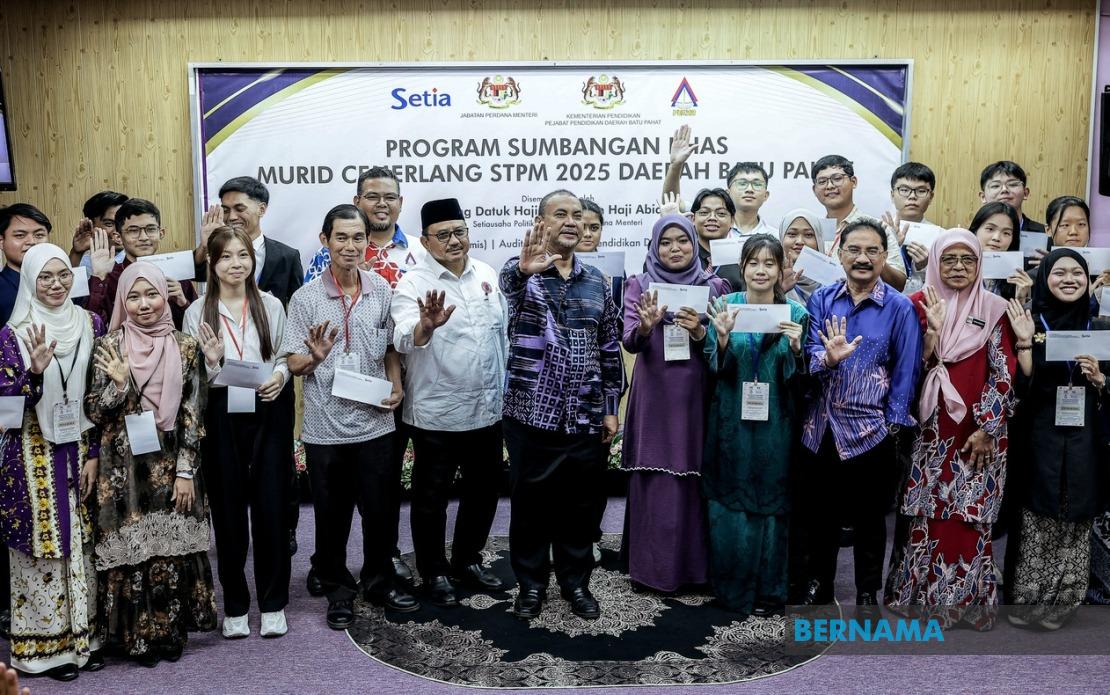
The Prime Minister's Office has extended financial recognition to 214 exceptionally performing 2025 STPM students throughout Batu Pahat district, marking a significant gesture toward acknowledging academic merit at the pre-university level. The awards ceremony, held at the Batu Pahat District Education Office auditorium, brought together top achievers from 16 secondary schools across the area, reflecting the government's commitment to nurturing talent within the district and motivating the next generation of Malaysian learners.
Datuk Azman Abidin, who serves as Political Secretary to the Prime Minister, oversaw the presentation ceremony and elaborated on the strategic intent behind the initiative. Beyond the immediate financial assistance, he emphasised that the programme carries broader educational objectives, functioning as a tangible endorsement of sustained academic commitment and a catalyst for recipients to maintain their excellence while pursuing tertiary studies. The recognition extends beyond individual recipients, as Azman highlighted the programme's role in establishing role models who can inspire their peers to aspire toward similar achievements and academic rigour.
The initiative represents a deliberate policy choice to channel resources toward recognising and rewarding outstanding academic performance at the STPM level, a critical juncture in Malaysian students' educational trajectories. By distributing contributions across multiple schools within a single district, the programme ensures equitable representation and avoids concentration of recognition in a few institutions, thereby encouraging excellence across the broader secondary education landscape. This approach aligns with national efforts to decentralise educational incentives and strengthen academic standards across regions.
According to Azman, the government views this programme as an instrument for demonstrating institutional care and reinforcing its policy commitment toward educational empowerment. Rather than treating recognition as a one-off gesture, officials have indicated their intention to sustain the initiative subject to budget availability and potentially extend it to other districts and regions. Such scaling aspirations suggest the programme may evolve into a structured recognition framework that encompasses top achievers nationwide, establishing a systematic approach to rewarding academic excellence at the STPM level.
Among the recipients, 20-year-old Afida Auni Airulnizam, a former student of Sekolah Menengah Kebangsaan Tun Sardon in Rengit, articulated the personal significance of the contribution. For her, the award represented more than financial support; it constituted formal validation of her academic efforts and served as psychological reinforcement for her continued pursuit of higher education. As the younger of two siblings, she has drawn inspiration from her elder brother's university experience, motivating her ambition to pursue sports science at the tertiary level should she secure admission.
Airulnizam's experience reflects the broader context in which such recognition programmes operate within Malaysian households. For many families, STPM achievement represents a pivotal moment determining access to tertiary education, and financial contributions at this stage can meaningfully alleviate household burden while affirming parental investment in their children's education. The psychological impact of government recognition should not be underestimated, particularly for students from families where such validation may be the first formal acknowledgment of their academic accomplishments from state institutions.
Muhd Ammar Firdaus Mohd Fadzil, also 20 years old and a former student of Sekolah Menengah Kebangsaan Tun Ismail, similarly welcomed the contribution with recognition of its practical utility. His framing of the award explicitly centred on its role in reducing financial barriers to tertiary education preparation, highlighting a tangible concern among Malaysian families navigating the costs of university entry processes, examinations, accommodation, and related expenses. This pragmatic perspective underscores how financial recognition programmes can translate into concrete support for disadvantaged students otherwise burdened by education costs.
The concentration of the award ceremony in Batu Pahat reflects the district's particular standing within the education landscape of Johor. The selection of this specific location and the mobilisation of resources to recognise top performers suggests a deliberate regional focus, possibly reflecting electoral considerations or targeted capacity-building initiatives. Regardless of underlying motivations, the practical effect remains the same: 214 students receive tangible support and public recognition for their academic endeavours.
The expansion potential outlined by Azman introduces important questions about programme sustainability and equity. If the initiative extends beyond Batu Pahat to other regions, questions will inevitably emerge regarding selection criteria, funding allocation, and whether all states and regions receive equitable representation. The success of the programme will substantially depend on transparent criteria, consistent implementation, and communication of results to demonstrate that selection processes reflect genuine academic merit rather than administrative convenience or political preference.
For the broader Malaysian education policy context, this initiative signals a willingness to channel resources toward direct student support and recognition rather than exclusive institutional infrastructure investment. Such programmes can prove highly effective at motivating sustained academic effort among high-achieving students, particularly when recognition arrives at pivotal junctures such as post-STPM transition periods. The psychological and practical impacts of visible government support for academic excellence extend beyond immediate recipients to younger cohorts who observe recognition of achievement and develop aspirational goals.
The involvement of 16 secondary schools across Batu Pahat suggests that excellence is dispersed across the district's education system rather than concentrated in a few elite institutions. This distributional pattern, assuming it reflects genuine merit-based selection rather than predetermined quotas, offers encouraging evidence that quality education and capable students exist throughout the district. Such findings can inform future policy discussions about resource allocation and support mechanisms for secondary schools in less advantaged areas.
Moving forward, the stated intention to continue and potentially expand the programme requires clarification on several operational matters: the precise criteria governing recipient selection, the mechanisms ensuring transparency and fairness, the timeline for expansion to other districts, and the projected annual budget allocation as the initiative scales. Without such clarity, the programme risks appearing ad hoc or politically motivated rather than a systematic educational policy. Establishing clear parameters would enhance public confidence and ensure that recognition genuinely rewards the highest academic achievers across Malaysia's diverse secondary school landscape.

