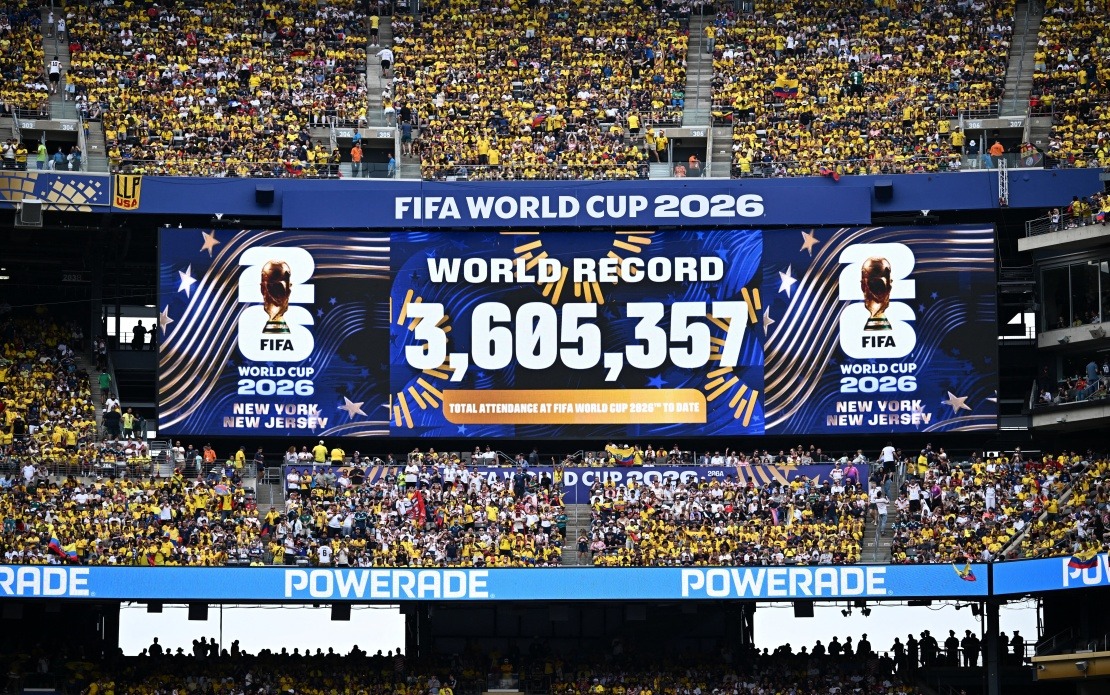
The 2026 FIFA World Cup etched its name into football history on Thursday as global attendance figures crossed the 3.6 million mark, officially surpassing the longstanding record set 32 years earlier. The historic announcement was made during Germany's encounter with Ecuador in East Rutherford, New Jersey, where the milestone was broadcast across stadium screens to roaring applause from the assembled crowd. This achievement represents a watershed moment for international football, demonstrating unprecedented appetite among fans worldwide to witness the tournament's matches across multiple continents.
The previous benchmark of nearly 3.6 million spectators had stood since the 1994 World Cup held in the United States, an event that itself had transformed perceptions of football's commercial and cultural potential in North America. That tournament featured 52 matches across its entire duration. By comparison, the 2026 edition had already surpassed this figure with 48 matches still remaining on the schedule, a remarkable acceleration that underscores how substantially the tournament's format has evolved and how deeply embedded the sport has become in contemporary popular culture.
The expansion of the 2026 World Cup to 48 participating nations, up from the traditional 32-team format, has fundamentally altered the mathematical possibilities for attendance generation. This structural change means the total number of matches has increased accordingly, providing multiple opportunities for fans across wider geographic territories to experience live football at the highest level. Should current attendance trends persist through the tournament's conclusion, total attendance figures could feasibly approach or even exceed seven million spectators, effectively doubling the previous record and establishing benchmarks that will influence tournament planning for decades to come.
A particularly striking statistic emerging from the 2026 tournament concerns venue utilisation rates. Stadiums hosting matches across the 16 designated host cities have maintained average occupancy levels exceeding 99 per cent, an extraordinarily high figure that reflects both meticulous planning and genuine mass enthusiasm for the competition. This near-capacity performance across virtually all venues suggests that organisers have successfully matched venue infrastructure with anticipated demand, avoiding the common pitfall of oversized stadiums operating substantially below capacity.
The geographic distribution of matches across 16 different cities has played a significant role in generating these attendance figures. By spreading the tournament across multiple metropolitan areas, FIFA expanded the potential fan base significantly, allowing supporters in various regions to attend matches without requiring extensive travel. This decentralisation approach contrasts with some previous tournaments that concentrated fixtures in fewer locations, thereby limiting accessibility for peripheral fan communities.
FIFA President Gianni Infantino characterised the attendance milestone as validation of football's enduring appeal and its capacity to unite diverse populations in shared celebration. The president emphasised that scenes witnessed across host stadiums reflected the sport's unique ability to transcend cultural and linguistic boundaries, creating moments of genuine collective joy. Such commentary positions the record-breaking attendance not merely as a commercial success metric but as evidence of football's societal significance and its role as a genuine connector of global communities.
For Southeast Asian football enthusiasts and the Malaysian sporting public, the 2026 World Cup's success carries particular relevance. While Malaysia did not qualify for this tournament, the region's growing engagement with international football and the expanding infrastructure for hosting major sporting events suggests that future tournaments could potentially be held across the region or involve greater Southeast Asian participation. The demonstrated capacity of North American venues to accommodate massive crowds and the logistics successfully executed across 16 host cities offer instructive lessons for countries considering bids for future major sporting competitions.
The 1994 World Cup's significance in establishing football's viability as a major commercial and cultural phenomenon in North America cannot be overstated. That tournament transformed perceptions of American football engagement and paved the way for subsequent growth in both the domestic Major League Soccer and international football's profile on the continent. The 2026 tournament appears to have built substantially upon this foundation, suggesting that the intervening three decades have witnessed genuine deepening of football's roots in North American consciousness and participation patterns.
The tournament's success in drawing massive crowds carries implications extending beyond attendance statistics into broadcast ratings, merchandise sales, and broader economic impact across host regions. Stadium occupancy at near-capacity levels typically correlates with strong television viewership, ticket market vitality, and significant expenditure by visiting supporters on accommodation, dining, and local services. These secondary economic effects often exceed the direct revenue from gate receipts, making the attendance achievement a proxy for broader commercial and cultural success.
Looking forward, the 2026 World Cup's attendance performance will likely influence FIFA's strategic thinking regarding tournament expansion and geographic distribution in future competitions. The successful accommodation of 48 teams across North America, combined with these record-breaking spectator figures, may validate the expanded format in the eyes of FIFA leadership and potentially encourage similar approaches in subsequent tournaments. For football administrators globally, including those in Southeast Asia, the data emerging from this tournament will inform venue planning, capacity assessments, and strategic decisions about bidding for and hosting major sporting events.
The convergence of multiple factors—expanded team count, dispersed geographic hosting, demonstrated enthusiasm across diverse populations, and modern stadium infrastructure—has created conditions for this historic attendance achievement. Whether this represents a permanent elevation in World Cup attendance benchmarks or a tournament-specific phenomenon dependent on North American enthusiasm remains to be seen. Nevertheless, the 2026 figures establish a new standard against which future tournaments will inevitably be measured, setting a high bar for organisers and investors considering bids for subsequent editions of football's premier international competition.

