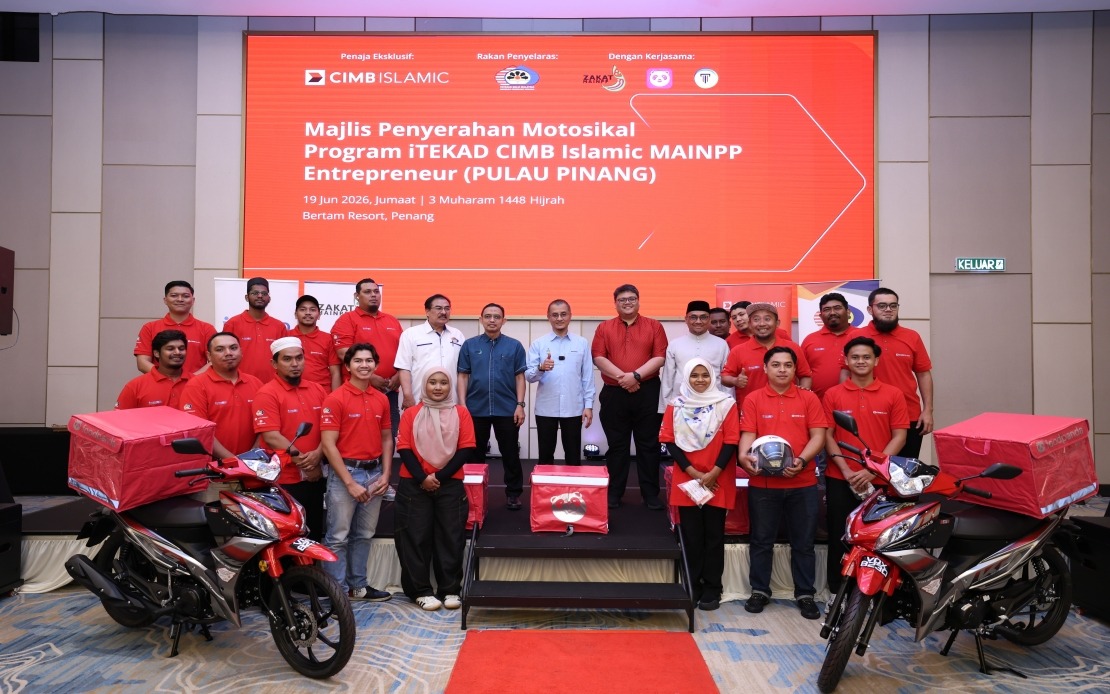
Twenty carefully selected entrepreneurs in Penang have received motorcycles and delivery equipment through the iTEKAD CIMB Islamic-MAINPP Entrepreneur programme, marking a significant push to equip vulnerable communities with tangible productive assets and pathways toward financial stability. The handover ceremony took place at Bertam Resort in Kepala Batas on June 19, underscoring the state government's commitment to transforming lives through strategic partnerships and targeted economic interventions for the asnaf demographic.
The initiative represents a carefully structured collaboration between multiple stakeholders, each bringing distinct expertise and resources to address poverty systematically. CIMB Islamic Bank Berhad and the Penang Islamic Religious Council, operating through Zakat MAINPP, serve as the primary financial anchors, while implementation partners including the Malaysian Youth Foundation, Taylor's Community and foodpanda Malaysia provide operational support and market access. This multi-stakeholder model addresses a fundamental challenge in development work: the recognition that sustainable change requires coordinated effort rather than isolated interventions by any single institution.
Penang Deputy Chief Minister I Datuk Dr Mohamad Abdul Hamid, who also chairs MAINPP, emphasised that the programme transcends simple asset distribution. Beyond motorcycles, participants receive comprehensive training covering basic financial management, workplace discipline and entrepreneurial fundamentals, positioning them to operate delivery businesses with greater professionalism and consistency. This holistic approach acknowledges that providing tools without corresponding knowledge and skills often leads to underutilised resources and missed opportunities for genuine economic advancement.
The financial architecture underlying the programme demonstrates deliberate alignment with Malaysia's broader development objectives. A seed fund of RM400,000 underpins the initiative, structured as a matching grant with equal contributions from CIMB Islamic Bank Berhad's Wakalah Zakat fund and Bank Negara Malaysia. This dual-source funding model reflects institutional recognition of the urgency surrounding asnaf economic empowerment while distributing responsibility across banking and regulatory authorities. Such funding arrangements also signal confidence in the programme's viability and outcomes.
The selection process itself reveals sophisticated programme management. From an initial pool of 151 applications, Zakat MAINPP implemented rigorous screening procedures that extended beyond simple administrative checks. Candidates participated in a residential Entrepreneurship Camp spanning June 3 to June 3, 2026, which functioned as both evaluative mechanism and immersive training ground. This approach ensures that motorcycle recipients represent individuals most likely to convert opportunity into sustained income generation, thereby maximising the developmental impact of limited resources.
For Malaysian readers and regional observers, this initiative carries implications extending beyond Penang's borders. Food delivery has emerged as a significant employment pathway across Southeast Asia, offering relatively low barriers to entry and flexible working arrangements suited to underserialised communities. By deliberately linking motorcycle distribution with foodpanda partnerships, the programme taps established logistics networks rather than requiring participants to build markets from scratch. This practical grounding distinguishes the initiative from aspirational programmes lacking commercial anchors.
The emphasis on zakat as a developmental instrument reflects evolving perspectives within Islamic finance and governance circles across the region. Traditionally conceptualised primarily as charitable almsgiving, zakat increasingly features in strategically designed poverty reduction frameworks that prioritise productive assets and income generation over consumptive relief. The iTEKAD programme exemplifies this shift, positioning zakat funds as catalytic capital for entrepreneurial activity rather than temporary assistance.
The initiative aligns with the Penang Islamic Religious Development Agenda 2030, which integrates economic empowerment within broader ummah development frameworks spanning education, family support and youth engagement. This positioning situates economic intervention within holistic community strengthening, recognising that sustainable poverty reduction requires simultaneous attention to multiple life dimensions. Malaysian policymakers increasingly recognise that siloed approaches to specific challenges—employment, education, family stability—often prove insufficient without complementary progress across interconnected domains.
Datak Dr Mohamad's characterisation of the programme as a catalyst rather than a solution reflects realistic development thinking. The motorcycles and initial training represent critical enablers, but genuine transformation depends on participants' sustained effort, market conditions and continued access to support systems. This framing also acknowledges that even well-designed interventions operate within broader economic contexts shaped by factors beyond programme control, from fuel costs to competition within delivery sectors.
The programme's significance for Southeast Asian development discourse extends to its demonstration of coordination between religious institutions and commercial entities. CIMB Islamic Bank Berhad's integration of zakat mechanisms with broader business operations illustrates how Islamic finance can facilitate development objectives while maintaining commercial viability. For Malaysia and neighbouring economies grappling with persistent inequality despite growth, such hybrid models merit careful study and potential replication with local adaptations.
Participants selected for motorcycle grants represent individuals whom evaluators assessed as possessing requisite motivation, basic business understanding and commitment to structured work. The transformation of 20 lives through integrated support—productive assets, training, ongoing mentorship and market access—generates measurable outcomes while contributing to broader poverty reduction targets. Success among this cohort may also create demonstration effects, encouraging additional asnaf individuals to pursue formal entrepreneurial pathways and potentially attracting similar investments from other institutions.
Looking forward, the programme's sustainability depends partly on participants' ability to generate sufficient revenue through delivery operations to maintain motorcycles, manage fuel and vehicle maintenance costs, and build savings. Programme designers acknowledge this reality implicitly through their emphasis on financial management training and work discipline. The involvement of foodpanda Malaysia as implementation partner suggests potential for long-term engagement, as the platform benefits from reliable delivery networks while participants gain stable income sources.

