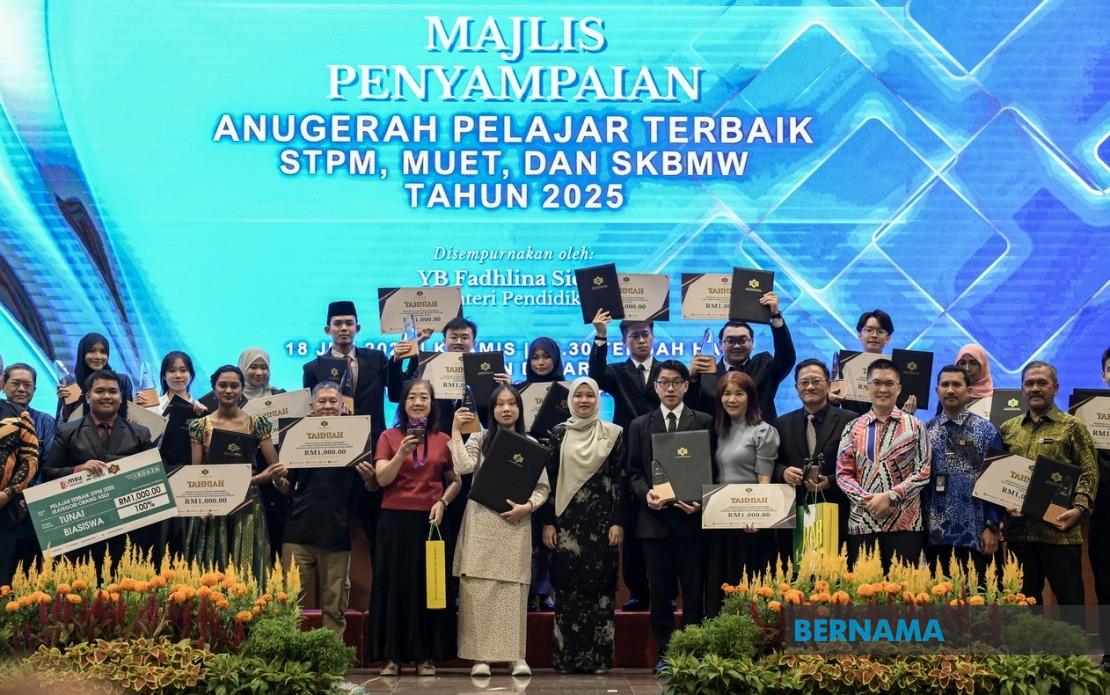
Education Minister Fadhlina Sidek has announced that 18 of Malaysia's highest-achieving STPM students from the 2025 cohort will receive full tuition fee scholarships from public universities, marking a fresh commitment to recognising academic excellence and bolstering the country's Form Six system. The announcement came during a ceremony at the Malaysian Examinations Council building in Kuala Lumpur on June 18, where the ministry also presented awards honouring the top performers across STPM, the University of Malaysia English Test (MUET), and the Certificate of Proficiency in Malay for Foreigners (SKBMW).
This scholarship scheme represents a departure from previous practice and signals a coordinated effort by Malaysia's public universities to actively compete for and retain high-performing students entering undergraduate programmes. Rather than leaving such decisions to individual institutions, the tuition fee sponsorships now flow directly from university commitments made at the policy level, suggesting a structural change in how Malaysia's higher education sector approaches talent acquisition and student support. The initiative underscores growing recognition that financial barriers, even for top students, can influence university choices and career trajectories.
Fadhlina positioned the scholarship initiative as integral to the government's broader agenda of reinvigorating the Form Six pathway, which has faced years of declining enrolment as students increasingly opt for diploma programmes or private pathway qualifications. By offering concrete financial incentives at the point of university entry, the government aims to demonstrate tangible rewards for students who complete the traditional academic route through STPM. The minister stressed that all public universities have committed to participating in this scheme, representing institutional buy-in across the sector rather than a limited or pilot programme.
The timing of this announcement arrives alongside other policy measures designed to make Form Six more attractive to secondary students and their parents. The government has simultaneously expanded the network of Form Six Colleges, introduced smartboard technology in classrooms, enhanced early childhood assistance programmes, and distributed MADANI Book Vouchers to support student learning materials. These layered interventions suggest a recognition that increasing enrolment requires addressing multiple pressure points—infrastructure, teaching quality, financial access, and resource availability—rather than relying on any single initiative.
Performance metrics released during the ceremony indicate that the STPM cohort continues to improve academically. The 2025 STPM cohort achieved a national cumulative Grade Point Average of 2.88, an increase from 2.85 in the preceding year, though the improvement is modest and incremental rather than dramatic. For Malaysian education observers, this steady upward trajectory provides encouragement that systemic changes are having measurable impact, though questions remain about whether current rates of improvement will prove sufficient to address long-standing concerns about international competitiveness in academic standards.
The scholarship programme reflects broader global trends in higher education competition, where universities increasingly use financial aid to attract high-achieving students who strengthen institutional rankings and peer group academic profiles. For Malaysia's public universities, which collectively enrol the majority of the country's undergraduates, these scholarships represent investment in human capital development while simultaneously addressing the perception that public institutions struggle to compete with private universities and overseas programmes in attracting elite students. The scholarships also potentially reduce the financial burden that keeps many talented Malaysian students from disadvantaged backgrounds from pursuing university education.
From a regional perspective, Malaysia's initiative echoes similar scholarship expansions undertaken across Southeast Asia as governments seek to develop highly educated workforces capable of competing in knowledge-based economies. Countries including Thailand, Vietnam, and the Philippines have pursued comparable strategies, using merit scholarships to encourage completion of advanced secondary qualifications and channel talented students into priority fields. Malaysia's approach, however, appears more specifically targeted at sustaining the STPM pathway rather than broadly competing across all pre-university options, reflecting policy priorities distinct from some neighbouring nations.
The presence of Deputy Education Minister Wong Kah Woh alongside Malaysian Examinations Council leadership and Education Malaysia's director-general emphasised the whole-of-government coordination underpinning the announcement. This bureaucratic alignment is significant because scholarship initiatives often falter when different government agencies pursue conflicting priorities or when implementation responsibility becomes unclear. The public gathering of senior officials suggested clear ownership of the scheme and commitment to its execution, though outcomes ultimately depend on consistent university participation and student awareness of the opportunity.
For Malaysian secondary school students and their families, particularly those from middle and lower-income households, the scholarship programme represents genuine expanded access to publicly funded undergraduate education at zero tuition cost. This addresses a persistent equity concern in Malaysian higher education, where despite official commitments to accessibility, financial constraints continue limiting who can pursue university study. The scheme's focus on merit ensures the scholarships target students with demonstrated capability, potentially creating role models and demonstrating achievement pathways within their communities.
Looking forward, the success of this initiative will be measured not merely by the 18 students who receive the initial scholarships, but by whether the programme expands as a sustained commitment and influences broader student choice patterns at the secondary level. Education officials will likely track whether STPM enrolment stabilises or grows following this announcement, and whether performance metrics continue improving across subsequent cohorts. The programme's visibility in schools and among families will prove crucial—many deserving students may remain unaware of the scholarships if promotion efforts remain limited to official announcements.